
Diving in La Palma
Diving between lava and Atlantic light
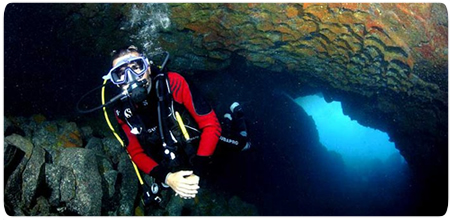
La Palma does not greet divers with a tropical coral reef, but with a character all its own: lava flows continuing beneath the surface, sheer walls, cracks, arches, caves and black sand. The contrast between dark rock and clear Atlantic light gives the island its distinctive atmosphere.
Parrotfish, groupers, barracudas, trumpetfish, moray eels, pufferfish and many invertebrates live among the rocks. Rays or sea turtles may pass by, while black coral grows at suitable sites in deeper water.
There is little mass dive tourism. Many dives begin from the shore and can be adapted to experience and daily conditions. Sheltered entries suit beginners, while walls, currents and deep formations require the appropriate training and a knowledgeable guide.
Dive sites around the island
La Palma's microclimates continue below the surface. When the east coast is rough, the west may offer better conditions, or the reverse. Local centres therefore often choose the site after assessing wind, swell, current and the group's experience.
Los Cancajos is a versatile area with accessible entries, lava walls, tunnels and shallower sections. The official La Palma description shows why training sites and varied dives sit so close together here.
In the south, Las Cruces de Malpique is one of the best-known sites: 40 stone crosses commemorate the Martyrs of Tazacorte at a depth of about 20 metres. Nearby Torre de Malpique, with dramatic relief and black coral, is considerably more demanding and should only be dived by experienced divers in suitable conditions.
On the west coast, the Tajogaite lava deltas have created a young underwater landscape since 2021. Its marine life is still developing, so access and suitable sites should be planned with an authorised local centre familiar with the area.
Conditions and preparation
Diving is possible throughout the year, although water temperature, visibility and sea state vary with season and weather. The often-quoted visibility of up to 50 metres is a best-case possibility, not a promise. The right wetsuit and flexibility over location matter more than a fixed calendar date.
Certification, recent experience, intended depth and any medical limitations should be discussed before booking. Beginners need theory, a clear briefing and a sheltered entry; caves, deep walls and current dives are for divers with the relevant training.
Allow enough time after the final dive before flying or travelling to high altitude. Many island roads climb quickly and Roque de los Muchachos rises above 2,400 metres, so plan the surface interval with your dive computer and centre.
The Marine Reserve and responsible diving
La Palma's Marine Reserve has protected the south-west coast since 2001. Its 3,455 hectares include rugged lava seabeds, ravines, caves and rich marine life. Scuba diving is permitted outside the integral reserve with prior authorisation; a local dive centre is the simplest way to arrange this correctly.
Current zones and conditions are published by Spain's Ministry of Agriculture, Fisheries and Food. These rules should always take precedence over old maps or private descriptions.
Good buoyancy protects lava formations and fragile organisms. Do not touch or feed wildlife, remove nothing and keep fins away from the seabed. This helps preserve the island's quiet underwater landscape for the divers who follow.
Current dive centres in La Palma
BuceoSub La Palma
Based in Los Cancajos on the east coast, offering guided shore dives, try dives, courses and snorkelling. BuceoSub website
Dive Community La Palma
Beside the sea in Los Cancajos, with PADI training and guided dives around the island. Dive Community website
Punkfish Diving
Fuencaliente centre focusing on the volcanic south, training and technical diving. Punkfish Diving website
Blue Magma Diving
West-coast centre offering training, excursions and activities around Tazacorte. Blue Magma website
Black Sand Diving
Los Llanos de Aridane centre offering small groups, snorkelling, try dives and PADI courses. Black Sand Diving website