
Roque de los Muchachos Observatory
A window on the universe above the clouds
Roque de los Muchachos Observatory, usually shortened to ORM, stands beside Caldera de Taburiente National Park in the municipality of Garafía. Its telescopes are spread across the summit area at about 2,396 metres, while the nearby Roque de los Muchachos reaches 2,426 metres and is the highest point on La Palma.
The summit often rises above the trade-wind cloud layer. Dry, stable air, low atmospheric turbulence and many dark nights create excellent observing conditions. It is still a high-mountain environment: wind, ice or snow can temporarily affect both scientific work and road access.
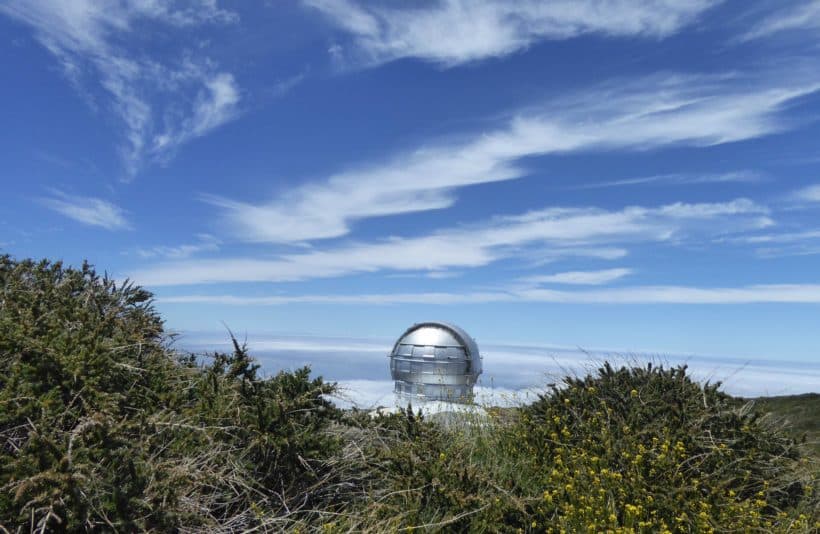
Together with Teide Observatory on Tenerife, the ORM forms the Observatorios de Canarias run by the Instituto de Astrofísica de Canarias (IAC). Around sixty institutions from more than twenty countries use instruments at the two sites. The summit is therefore not merely a viewpoint, but an international workplace for science and engineering.
Since 1988, the Sky Law has protected astronomical quality by regulating outdoor lighting, radio emissions and other influences on the atmosphere and night sky. This is why many street lights on La Palma use warm light directed towards the ground.
From an international agreement to a research centre
Spain, Denmark, Sweden and the United Kingdom signed the international agreement on astrophysical cooperation in Santa Cruz de Tenerife on 26 May 1979. Germany and other partners joined later. Spain provided the sites and common infrastructure, while observing time was secured for Spanish research.
The observatory was formally inaugurated on 29 June 1985 in the presence of scientists and heads of state. Its first group of domes has since grown into one of the world's most complete telescope collections, with national institutions operating their instruments in cooperation with the IAC.
A distinctive working rhythm lies behind the silver and white domes. Technicians maintain mirrors, cameras, software and power systems; astronomers prepare observations or control instruments remotely. Many telescopes operate automatically, but the mountain remains an active scientific site around the clock.
From a giant mirror to gamma rays
The best-known instrument is the Gran Telescopio Canarias, or GTC and GRANTECAN. Its primary mirror consists of 36 hexagonal segments working together as the equivalent of a 10.4-metre mirror. Since its formal inauguration in 2009 it has remained among the largest and most advanced optical-infrared telescopes in the world.

The ORM explores far more than visible light. The William Herschel Telescope, Telescopio Nazionale Galileo, Nordic Optical Telescope, Liverpool Telescope and other facilities study stars, galaxies, exoplanets and changing objects. The Swedish Solar Telescope instead resolves remarkably fine structures on the Sun.
MAGIC and the Large-Sized Telescopes detect brief atmospheric flashes caused by very-high-energy gamma rays. LST-1, completed in 2018, has been joined by three more large telescopes. In 2026 this four-telescope group at CTAO-North was in the final preparation stage for joint scientific operation.
Classical reflecting telescopes, robotic instruments, solar observation and high-energy astrophysics therefore share the same mountain. The Instituto de Astrofísica de Canarias provides an up-to-date overview of the facilities.
Visiting the observatory
The ORM is first and foremost a working scientific site. Visits for individuals take place during daylight, in small groups and only with advance booking. Accessible telescope buildings depend on research operations and weather, so visitors must follow the instructions of the qualified Starlight guides.
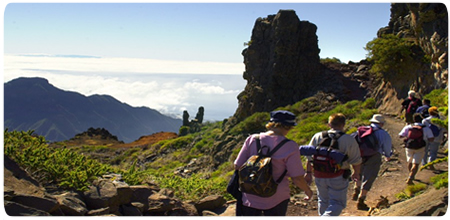
The meeting point is the Roque de los Muchachos Visitor Centre, which opened in 2021. Its exhibition introduces the telescopes, basic astrophysics, the value of the protected sky and the host municipality of Garafía. It can be visited as an attraction in its own right and should not be confused with a booked tour of the scientific facilities.
Access is via the winding LP-4 mountain road. At around 2,400 metres there is less oxygen, sunlight is intense and temperatures can be far lower than on the coast. Warm clothing, sun protection and closed shoes are sensible even in summer; check weather, road conditions and possible closures before setting out.
The scientific compound is closed to the public at night. Designated astronomical viewpoints and guided tours outside the site are available for stargazing. The IAC visits page provides current booking and access conditions. ORM news also appears in the German-language observatory section of the La Palma 24 Journal.